
Poinsettia Pops
Poinsettia Pops | December 6, 2025 | 7:00 pm | Union Colony Civic Center
With the Greeley Chorale and Greeley Children’s Chorale
Conducted by Lowell Graham and guest conductor Clelyn Chapin
Program Notes by Bailey Dorsey
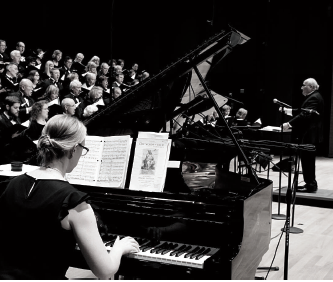
Greeley Chorale
The Greeley Chorale originated in 1964 as a community chorus under the direction of Dr. Howard Skinner. Over the years the Chorale has grown from a 40-voice ensemble in 1964, to more than 90 voices today. Along the way, the Chorale has been an integral part of community celebrations, such as the downtown Christmas tree lighting, the Weld County “Concert for Peace”, the Hospice Tree of Memories lighting, UNC’s “Concert Under the Stars”, BT Voices for Hospice, City of Greeley Cinco de Mayo celebrations, the Exchange Club’s “Healing Field”, the Union Colony Civic Center 25th Anniversary Celebration, and the Greeley Independence Stampede, where the Chorale is a perennial performer of the national anthem. The Chorale also helped create and support the Greeley Children’s Chorale, now an independent organization. Celebrating its 61st season, the Chorale offers 3 concerts a year, plus its annual “Cabaret & Cabernet” fundraiser in February.
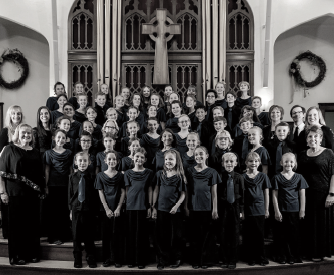
Greeley Children’s Chorale
The Greeley Children’s Chorale was founded by Kay (Copley) Boyd in 1990 and consists of two auditioned choral groups: Peak Performers (grades 5–8) and Summit Singers (grades 3–6), as well as one non-auditioned group: Valley Voices (grades 2–4). The Children’s Chorale has appeared with the Greeley Philharmonic Orchestra, the Greeley Chamber Orchestra, the Youth Orchestra of the Rockies, the Kream of the Krop Big Band, UNC Choirs, and the Greeley Chorale. In 2024, GCC was inducted into the Greeley Arts Legacy Hall of Fame. They enjoy performing their own a cappella version of the Star Spangled Banner at UNC sporting events and Colorado Rockies games. The Chorale performed at the National Orff Music Educator Conference in 2013 and made its third appearance at the Colorado Music Educators Association (CMEA) Conference in January 2016 to much acclaim. They are proud to have served the children, families and arts community of Weld County for over 30 beautiful seasons!

Colorado-based composer, musician and educator, Dylan Fixmer, is a genuine and passionate artist whose works reflect his diverse music career. Classically trained at University of Colorado and Indiana University Jacobs School of Music, Fixmer’s music is inspired by the beauty of nature and the human spirit, and draws upon a multitude of musical styles and traditions. Fixmer is currently the Composer-in-Residence for the Greeley Philharmonic Orchestra that premiered his Concerto for Violin: In Memory of Terri Sternberg with violinist Sarah Off, “which received a rapturous reception” (The Times of London) on September 24, 2022, and his Seven Symphonic Portraits: A Weld County Reflection on October 14, 2023.
As a multi-faceted and imaginative composer, Fixmer writes for multifarious contexts from orchestral and traditional solo and ensemble work, to theater, choir, film, and narrative including music for the birth center at the UCHealth Greeley Hospital, the soundtrack for the audio book Adventures of a Mystic Warrior by Robert Rocco D’Ordine, and author Craig Child’s multi-media production “Dark Night.” Fixmer’s Four Portraits for Strings was selected as Editor’s Choice by J.W. Pepper in 2023 and his music has been featured and premiered internationally on Colorado Public Radio Denver and CPR Classical, Radio Classique - Paris, The Times of London, and Le Figaro. An active and dynamic performing artist, Fixmer currently performs with his band “Traditionish”, in addition to various solo and ensemble performances. He has appeared with artists from Glen Valez and Loire Cotler to Blackie O’Connell and Cyril Cyril O Donoghue to Gao Hong, and in performance venues from the Lauderdale House in London and Boettcher Hall in Denver to the IBar Ranch in Gunnison. He has recorded numerous albums including Embodying Rhythm Marimba Ensemble’s Music for Everyday Life and Traditionish’s self-titled album. Fixmer is a faculty member of Music Composition at the University of Northern Colorado.
Bells of the Winter Range (6’)
“Bells of the Winter Range” by Dylan Fixmer was commissioned by the Greeley Philharmonic Orchestra in 2021. He is a graduate of the University of Colorado and the Jacobs School of Music at Indiana University. He currently serves as adjunct faculty in music composition at the University of Northern Colorado. “Bells of the Winter Range” is inspired by the Christmas experience along the Front Range. It is a medley of tunes including "Deck the Halls," "The Twelve Days of Christmas," "Niño Lindo," "The Snow Lay on the Ground," "The Apple Wassail," "In the Bleak Midwinter," and "I Saw Three Ships."
A Christmas Festival (8’)
Leroy Anderson was asked to compose a Christmas overture for the Boston Pops in 1950. “A Christmas Festival” was first performed in the heat of summer, on June 12, 1950. While the original version was around nine minutes long, Anderson wrote a second, shorter version in 1952. The composition highlights many Christmas favorites, including “Joy to the World,” “Deck the Halls,” and “Silent Night.”
Trudging Grimly through the Snow (a la Shostakovich) (8’)
What if Shostakovich had composed Jingle Bells? Eric Galluzzo answers this question in “Trudging Grimly through the Snow (a la Shostakovich).” Galluzzo writes, “Apart from being half an hour long, we certainly wouldn't be ‘dashing through the snow...laughing all the way,’ we'd be trudging grimly through the snow, lamenting the frailty of the human condition all the way — hence the title.” Galluzzo includes many clever nods to Shostakovich, including the famous DSCH (D, E♭, C, B) motif. Musical fragments are inverted and augmented, much like how Shostakovich would develop thematic material.
La Boutique Fantasque Concert Suite (7’)
La Boutique Fantasque, also known as The Fantastic Toyshop, premiered in 1919. The ballet was arranged for orchestra by Ottorino Respighi and was based on piano pieces by Gioachino Rossini. La Boutique Fantasque centers around a toy shop run by a talented toymaker who crafts dancing dolls. The dolls dance a mazurka and a tarantella; however, a pair of can-can dancers impress the customers most. The customers make plans to buy the can-can dolls, with one doll going to an American and the other going to a Russian. Determined to stay together, the dolls hatch a plan. The next day, the can-can dolls go missing, and when the patrons return to complete their purchase, the other dolls attack, driving out the buyers.
Joy to the World (2’)
“Joy to the World” took decades to become the song we know today. The carol is based on Psalm 98 and was paraphrased by the English hymnist Isaac Watts in 1719. Over 100 years later, this text was discovered by the Boston-based music educator, Lowell Mason. He set the text to music, incorporating elements of Handel’s Messiah. The tune was published in Occasional Psalm and Hymn Tunes in 1836 and was originally titled “Antioch.” This arrangement is part of the Arthur Harris Christmas Series.
Sleigh Ride (3’)
“Sleigh Ride” by Leroy Anderson evokes images of frosty joyrides. However, the piece was not written in a wintry paradise. After being released from active duty, Anderson left Iceland and spent the summer of 1946 in Woodbury, Connecticut. “Sleigh Ride” was inspired by a miserable heat wave that summer. “Sleigh Ride” was later completed in 1948. The piece incorporates specific instruments and techniques to imitate an icy voyage. Sleigh bells and temple blocks imitate the clip-clop of the horse. Near the end, a trumpet imitates a horse’s whinny by half-valving and shaking.
The Christmas Song (4’)
Like “Sleigh Ride,” “The Christmas Song” was written in an attempt to escape the oppressive summer heat. On a suffocating summer day in 1945, Mel Tormé headed over to the home of Bob Wells, one of his writing partners. Wells was not home. While looking for him, Tormé stumbled upon a spiral pad that read:
“Chestnuts roasting on an open fire
Jack Frost nipping at your nose
Yuletide carols being sung by a choir
And folks dressed up like Eskimos."
When Wells appeared, he explained that he wrote the lyrics to cope with the heat. With the two now working together, it took less than an hour to finish the lyrics. In 1946, Nat King Cole first recorded “The Christmas Song,” and it has since been recorded over 80,000 times.
Go Tell it on the Mountain (3’)
“Go Tell It on the Mountain” is an African American spiritual. While its exact origins remain mysterious, the song was popularized by John Wesley Work, Jr., who first published it. Work studied and taught Greek and Latin at Fisk University, but music was his passion, and he was involved with the Fisk Jubilee Singers. Work believed that spirituals were a powerful tool for teaching the Bible.
Joy to the World (5’)
“Joy to the World” took decades to become the song we know today. The carol is based on Psalm 98 and was paraphrased by the English hymnist Isaac Watts in 1719. Over 100 years later, this text was discovered by the Boston-based music educator, Lowell Mason. He set the text to music, incorporating elements of Handel’s Messiah. The tune was published in Occasional Psalm and Hymn Tunes in 1836 and was originally titled “Antioch.”
Star of Bethlehem from Home Alone (3’)
Every Christmas, Home Alone brings families together. The idea came about when John Hughes, the film’s writer and producer, was getting ready for a family trip. As he was made a packing list, he couldn’t help but wonder what chaos would ensue if he accidentally left his children behind. The original composer for Home Alone was not John Williams but Bruce Harold Broughton. When Broughton withdrew from the project at the last minute, John Williams quickly joined the team. The film score balances humorous motifs with tender tracks, like “Star of Bethlehem."
Gloria (4’)
The Gloria is part of the Catholic Mass. This hymn, which praises God, is also known as the “angelic hymn.” The first words of the Gloria echo what the angels sang when Christ was born. John Leavitt has arranged this traditional hymn in a celebratory choral setting.
Shepherd's Pipe Carol (3’)
John Rutter’s “Shepherd's Pipe Carol” was composed in 1966. It depicts the jubilation of traveling to see the newborn Jesus in the manger. Lyrics such as "Dance and sing for joy that Christ the newborn King is born” emphasize this joy. The piece uses complex rhythmic devices, including syncopation and hemiola, which contribute to its lively character.
Angels We Have Heard on High (6’)
“Angels We Have Heard on High” celebrates the birth of Jesus Christ and derives from the French carol “Les Anges dans nos Campagnes.” The chorus, “Gloria in excelsis Deo,” translates to “Glory to God in the highest.” The first word of the chorus, “Gloria,” is melismatic, meaning that one syllable is stretched out over multiple pitches.
This concert is sponsored by Robert and Diane Miller, Sears Real Estate, and Weld Community Credit Union.