
On the Move: American Snapshots Program Notes
On the Move: American Snapshots
Saturday, October 17, 2026 | 7:00 PM | UNC Campus Commons
Maestro Lowell Graham
Program notes by Natalie Morehead and Alexandre Larson-Reyes
Samuel Barber School for Scandal Overture (9 minutes)
Samuel Barber helped shape American styles of music in the 20th century. Originally composed in 1931 as his graduation piece from the Curtis Institute of Music, the School for Scandal overture was written as a musical version of the 1777 play by Richard Sheridan. The comedy is structured around satirical gossip in upper-class societies. Barber's piece consists of humorous and energetic themes to characterize the play’s plotlines along with slower and sophisticated melodic lines to emphasize romantic motifs between main characters Lady Sneerwell and Charles Surface.
James David Tin Lizzies on Old Fall River
James David is a composer and music theory professor living in Colorado who takes influence from 1920’s jazz and southern contemporary music. The name “Tin Lizzies on Old Fall River” comes from a single-lane Old Fall River Road near Estes Park built between 1914 and 1920. The road is steep and narrow, and its winding paths can be heard by metric changes between faster tempos, representing its switchback turns. David also illustrates an old Model T Ford, often called a Tin Lizzie at the time, using short slides in the trombones to represent the struggling engine at high altitudes. This piece is about the journey along the Old Fall River road and is dedicated to the music director of the Colorado Springs Chorale and the Stratus Chamber Orchestra in Denver, Adam Torres.
Aaron Copland Clarinet Concerto (17 minutes)
Aaron Copland’s two-movement piece, Clarinet Concerto was originally a commission for jazz clarinetist Benny Goodman. What surprises listeners is the smooth, breakless transition between the two movements. The first movement, starting off softer, emphasizes skill and beautiful tone before gradually picking up speed with broken chords. This moves into the well-known jazzy ragtime and Charleston-inspired second movement. Copland completed the piece during his 1947 trip to South America, where he incorporated Brazilian and Latin themes that can be heard throughout the piece.
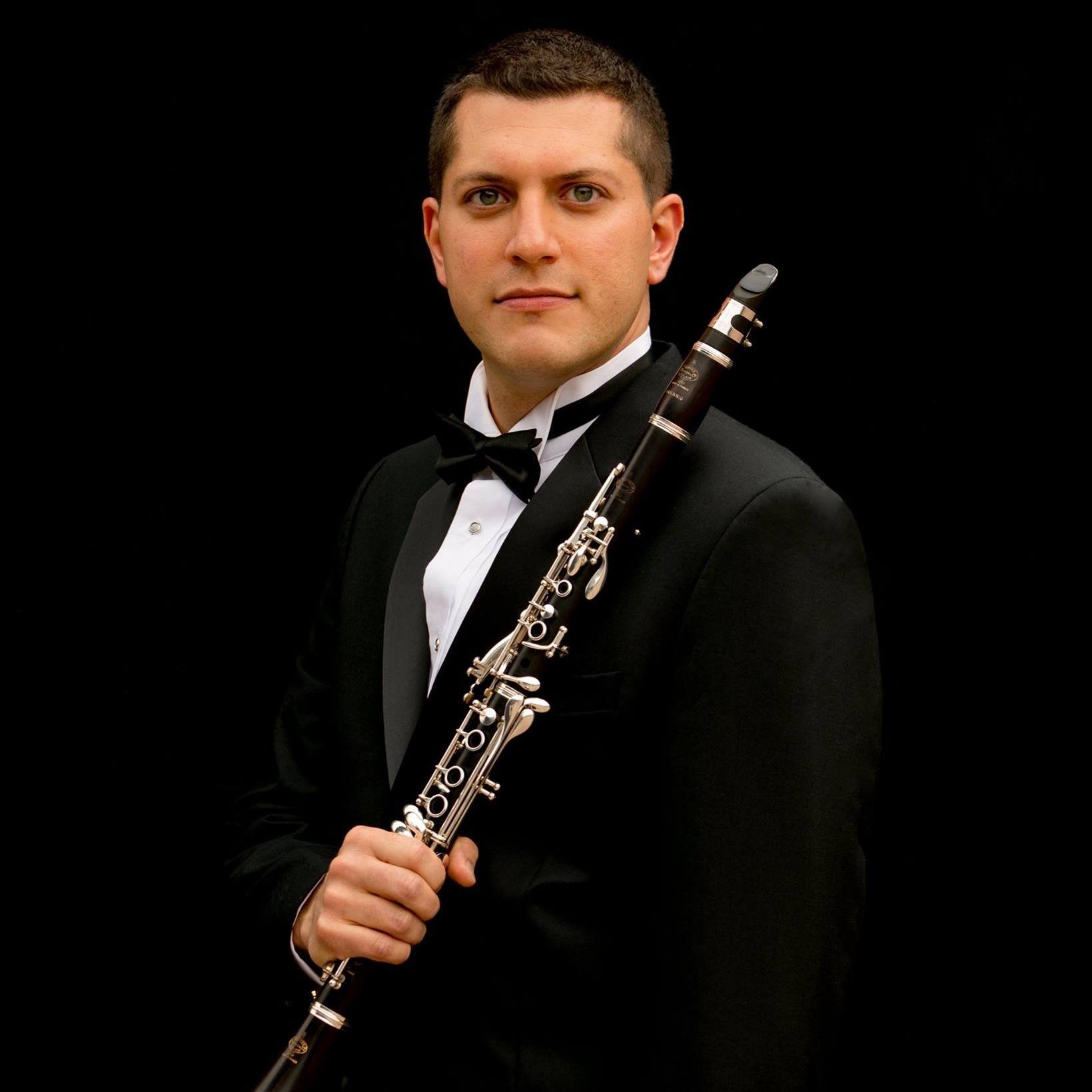
Robert Vitale, a native of Long Island, New York, joined the Greeley Philharmonic Orchestra as principal clarinet in September of 2016. He moved to Colorado Springs in 2014 after being awarded a position with the United States Air Force Academy Band. As a member of the Academy Band, he performs regularly with the Concert Band, Ceremonial Band, Jazz Ensemble and one of their eclectic chamber ensembles, Academy Winds. He holds a Bachelor’s Degree in Music Education from George Mason University, and a Masters of Music in Clarinet Performance from Stony Brook University. His principal instructors include Mitch Kamen, Dr. Brian Jones, Lora R. Ferguson, and Alan R. Kay. While attending George Mason University, Robert was principal clarinet for The Symphony Orchestra, Wind Ensemble and Concert Band. He was also featured as an honors recitalist in 2007, and was selected as the winner for the 2008 concerto competition when he performed the Mozart Clarinet Concerto K. 622. While attending Stony Brook University, he performed in the Symphony Orchestra and made his Lincoln Center (New York) debut premiering a new composition with their Contemporary Chamber Players ensemble. Mr. Vitale is a very enthusiastic educator and takes every opportunity to mentor young musicians. His tenure with both the GPO and the Academy Band has led him to perform master classes and clinics throughout the entire Front Range. In July of 2023, Robert was selected to perform the Artie Shaw Clarinet Concerto at the International Clarinet Festival conference held in Westminster, CO where he received a standing ovation for his rendition. It gives him great pleasure to call Colorado Springs his home while he finishes pursuing his military career. When getting away from the clarinet, Robert is a progressing racecar driver and a dedicated father to his dog Terry the Doodle!
William Schuman Newsreel in Five Shots (7 minutes)
William Schuman wanted to write music that could be played by children. The five movements in this piece paint pictures of articles found in a New York newsreel including a “Horse Race,” “Fashion Show,” “Tribal Dance,” “Monkeys at The Zoo,” and “Parade.” Schuman uses galloping themes, strutting rhythms, instrumental conversation, quick motifs and trills, and march-like percussion to symbolize each movement.
Howard Hanson Symphony No. 2 Romantic (30 minutes)
Symphony No. 2 Romantic was commissioned in 1930 by Serge Koussevitzsky for the 50th anniversary of the Boston Symphony Orchestra. As one of the most-recorded twentieth-century American symphonies, this piece was known as a breakthrough to a new era of music and heavily impacted American symphonies. The second theme in the first movement, called the Interlochen Themes, reoccurs heavily in the following two movements. Similar themes are shared amongst them, but each movement carries its own ideas, from nostalgia and horn solos in the second movement to grandiosity and energy as the third movement comes to a heroic conclusion. Due to its popularity, the themes can be found in the closing credits of the movie Alien and was used as a model for E.T. by John Williams.